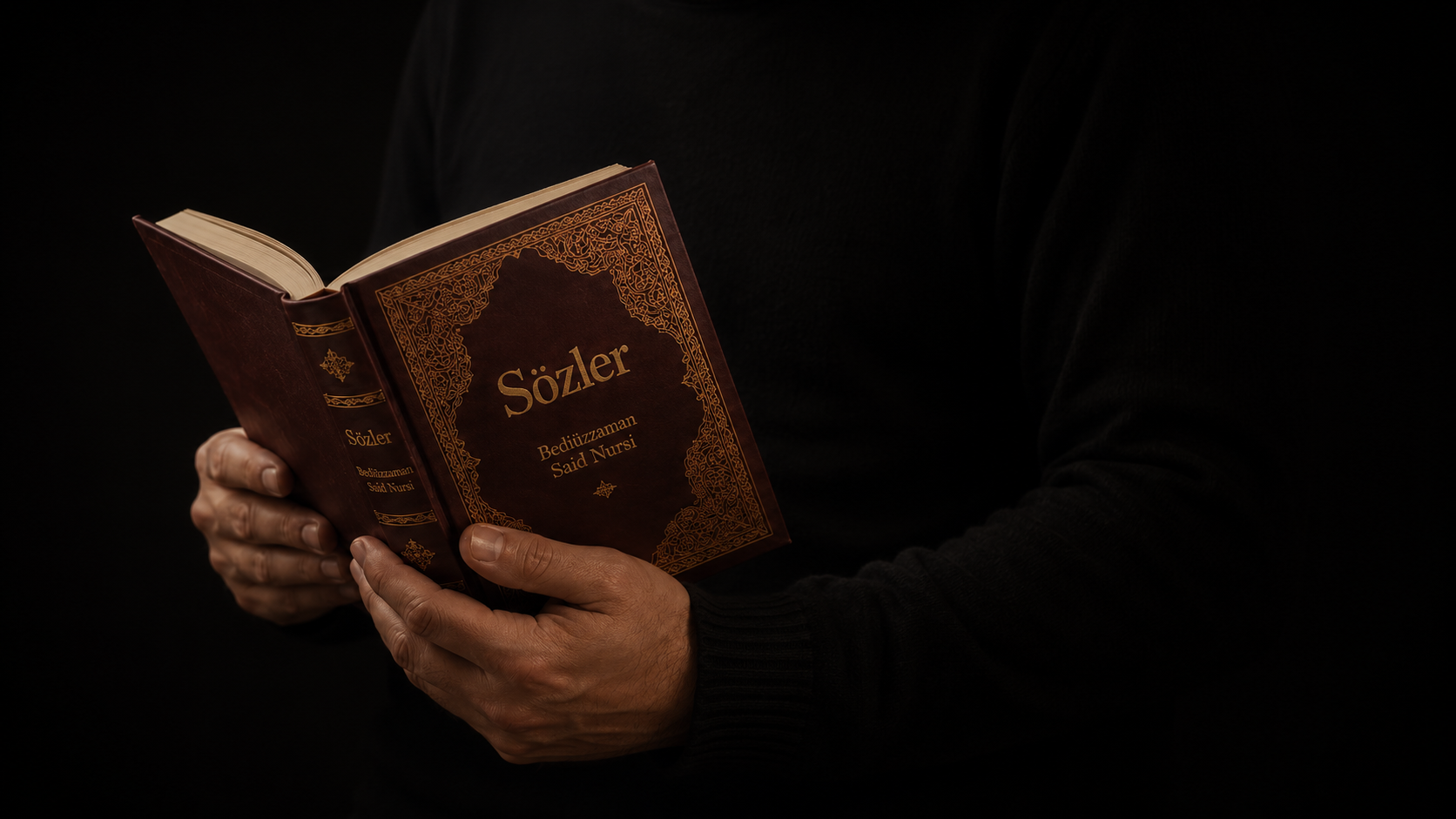
Risale-i Nur is often described as a powerful and authentic commentary on the Qur’an. Yet it is not a commentary in the conventional sense alone.
Traditional works of tafsir commonly explain the language of the Qur’an, the meanings of its words and sentences, the context of its verses, and the principles and rulings they contain. Risale-i Nur does not disregard this form of interpretation. Its central purpose, however, is different. It turns directly towards the truths of faith expressed by the Qur’an and seeks to explain, demonstrate, and establish them through reason, reflection, observation, and spiritual insight.
It is, in this sense, a spiritual commentary: one that does not merely explain what the Qur’an says, but seeks to make its truths visible within the human being and throughout the whole of existence.
Risale-i Nur does not simply teach a person what to believe. It seeks to teach them how to see.
A person may say that they believe in God and yet continue to look upon the world as though most things have no real connection to Him. They may say, “God created everything,” while inwardly treating causes, nature, and material processes as though they possessed power and meaning of their own. Faith then becomes separated from life. It is remembered at certain times, confined to certain places, and reduced to inherited beliefs, religious language, and the outward fulfilment of rules.
Religion remains, but its spirit gradually disappears beneath habit.
The work of Risale-i Nur begins by lifting this veil of familiarity from the human gaze.
We become accustomed to the rising of the sun, the opening of a flower, the beating of the heart, the formation of life, the preservation of memory, and the arrival of provision through the earth. Because these things happen continually, we begin to regard them as ordinary. Because we regard them as ordinary, we cease to wonder. And when wonder disappears, reflection soon disappears with it.
Yet nothing in existence is truly ordinary.
Ordinariness does not belong to creation. It belongs to the gaze that has become accustomed to it.
A leaf is not merely a leaf. Its delicate existence is connected to the sun, the air, the water, the soil, and the balance of the entire earth. Its form, colour, growth, and purpose carry a meaning far greater than anything it could have produced by itself.
A bird’s flight is not merely a biological movement. Its wings, its instinct, its ability to find direction, the provision placed before it, and the tenderness with which it cares for its young reveal knowledge, power, wisdom, and mercy acting together.
Risale-i Nur teaches the human being to look upon created things not as objects whose meaning ends within themselves, but as signs whose deepest meaning points beyond themselves.
A letter is not written merely so that its shape may be admired. It exists to carry a meaning. In the same way, every being in the universe carries a meaning that speaks of the One who brought it into existence.
For this reason, to look upon a flower and say only, “How beautiful it is,” is an incomplete reading. The deeper truth appears when the gaze moves from the flower to its Maker and says, “How beautifully it has been made.”
Beauty does not belong to itself. Art does not conceal the Artist. It announces Him.
In the vision of Risale-i Nur, the universe is not a silent and purposeless mass of matter. It is a vast book. Every being is one of its words, every living creature one of its sentences, every season a turning page, and the heavens pages opening towards the infinite.
The Qur’an speaks through words. The universe speaks through forms, colours, movements, births, transformations, and deaths. One is the revealed speech of God; the other is the work written by His power.
These two books are not separate from one another.
The Qur’an teaches the human being how to read the universe, while the universe displays before the eyes the truths to which the Qur’an calls the mind and heart. One speaks of Divine unity, wisdom, mercy, resurrection, justice, and purpose; the other reveals their signs throughout creation.
Faith, therefore, is more than the acceptance of certain religious statements. It is the beginning of an entirely new way of seeing.
Through faith, the world ceases to be ownerless. Events are no longer without direction. Life is no longer an accidental interval between birth and disappearance. Death is no longer absolute extinction, and separation is no longer an eternal loss.
Faith may not remove every pain, but it removes the meaninglessness of pain.
It does not make death invisible, but it lifts the darkness from its face.
It does not prevent every separation, but it teaches the heart that no separation under the care of the Eternal One can be final.
The consolation offered by Risale-i Nur is therefore not an escape from reality. It is a deeper consciousness of reality.
For the same reason, faith cannot be reduced to fear, punishment, and reward.
Responsibility is real. Judgment, reward, and punishment are real. Yet the relationship between the human being and God is far greater than a calculation between escaping punishment and receiving reward. Worship is deeper than a transaction.
A person does not worship only to avoid Hell or to attain Paradise. They worship because they have been brought into existence, given life without having earned it, sustained at every moment, and surrounded by blessings they could never create for themselves.
True worship begins when the human being becomes aware of their createdness, their need, their weakness, and the countless gifts placed within and around them.
Prayer is not an interruption of life. It is the return of a scattered soul to its centre.
Supplication is not merely a list of requests. It is the sincere recognition of human need and Divine mercy.
Gratitude is not simply a word repeated by the tongue. It is to recognise the true Giver through the gift and to refuse to attribute blessings solely to chance, nature, material causes, or oneself.
Risale-i Nur does not reject religious rules or diminish their importance. It seeks to restore their spirit. A command followed without consciousness may preserve the outward form of religion, but faith asks that the form carry its meaning, that action be joined by intention, and that obedience grow into recognition.
Religion cannot be confined to a mosque, a prayer mat, or a religious book. It appears in the way a person speaks, remains silent, works, learns, loves, disagrees, judges, forgives, and treats another person’s heart.
The language a person uses reveals something of the faith they carry.
A religious understanding that is continually harsh, humiliating, and eager to condemn must ask whether it has preserved the spirit of the truth it claims to defend. Correct words spoken with arrogance can still wound. A truth presented without mercy and wisdom can become a wall rather than a door.
The way truth is communicated is not separate from truth itself.
The path of Risale-i Nur is therefore not built upon coercion or hostility. Its aim is not to defeat people, but to awaken the light of faith within them. It addresses the mind with evidence, the heart with meaning, the conscience with recognition, and the soul with hope.
A person surrounded by doubt cannot always be helped by another command. Sometimes the mind must first be convinced, the heart reached, and the forgotten signs of mercy made visible again.
This is why Risale-i Nur does not regard inherited faith as the final destination.
A person may first believe because their family believes, because they were raised within a tradition, or because religion belongs to the world into which they were born. Such faith has value. Yet in an age filled with doubt, materialism, distraction, and competing explanations of existence, it must become deeper and more conscious.
The truths of belief must be examined, understood, and rediscovered within one’s own mind and heart.
The faith sought by Risale-i Nur is tahqiqi iman: a verified and deeply grounded faith. It is not a surrender achieved by silencing reason, but a certainty strengthened by the investigation of the mind, the affirmation of the heart, the testimony of conscience, and the experience of the soul.
For this reason, reason and spirituality are not enemies. Nor are science and religion.
Science studies how creation functions. Faith asks what that functioning means.
To explain the structure of a cell does not remove the art within it. It reveals that art in greater detail. To discover a law of nature does not make a Lawgiver unnecessary. A law describes the regularity of an action; it does not possess the power to perform that action.
Risale-i Nur does not deny causes. It denies that causes create.
It does not deny nature. It sees nature as art, not as the Artist.
It does not reject scientific laws. It refuses to treat them as independent powers possessing knowledge, will, and creative ability.
Seen in this way, every field of knowledge may become a window opening towards knowledge of God. Physics reveals measure and order. Biology reveals knowledge, provision, and mercy within life. Astronomy confronts the human being with their physical smallness and the extraordinary value of the consciousness through which they contemplate the heavens.
The study of creation does not lead away from faith when creation is read correctly. It leads more deeply into wonder.
Yet Risale-i Nur does not direct the human gaze only towards the outer universe. It also sends the human being inward.
A person wishes to be powerful, yet may be defeated by something too small for the eye to see. They wish to be independent, yet cannot produce a single breath or command their own heart to continue beating. They desire permanence while their body moves each day towards death. They wish to protect everyone they love, yet cannot prevent time, illness, or separation.
Risale-i Nur does not present this weakness as a humiliation. It treats it as a window.
Human weakness points towards unlimited power. Human need points towards inexhaustible mercy. Human longing for permanence points beyond a world in which nothing remains.
The path of Risale-i Nur is gathered around four fundamental realities: weakness, poverty, compassion, and reflection.
Weakness means recognising the limits of one’s power.
Poverty means understanding one’s need for everything and knowing that one is the true owner of nothing.
Compassion means valuing beings for the sake of their Creator.
Reflection means moving from the outward appearance of things towards their inner meaning; from the work towards the act, from the act towards the Divine Name, and from the Name towards knowledge of God.
Within this vision, the human being is not the absolute master of the universe, but a conscious guest within it.
The earth is not their possession. It is a trust.
Animals are not merely instruments for use, plants are not merely materials for consumption, and nature is not merely a resource awaiting exploitation. Every creature has a value given to it by its Creator. Each fulfils its own purpose and carries its own signs.
This awareness necessarily changes human morality.
A person cannot truly see another being as Divine art and then treat it carelessly. They cannot see the world as a trust and still regard it as the unlimited property of their desires. They cannot consider their own life meaningful while treating the lives and hearts of others as insignificant.
When everything is understood as coming from the same power, arrogance loses its foundation.
Yet Risale-i Nur does not teach that God is contained within created things or that creation is a part of Him. No form can encompass Him, and no creature is Divine.
Created beings are signs and mirrors of His Names and attributes.
The mercy seen in a mother’s care points towards the All-Merciful. The provision prepared for living beings points towards the Sustainer. The order visible throughout existence bears the mark of wisdom. The distinct form given to every creature points towards knowledge, will, and artistry.
A mirror is not the sun, but it receives and displays its light.
In the same way, creation is not the Creator, but it carries signs through which He makes Himself known.
Risale-i Nur therefore neither sanctifies the created world nor empties it of meaning. It teaches the human being to read created things as meaningful letters pointing towards a truth greater than themselves.
Even transience takes on another meaning within this vision.
The fading of a flower does not mean that its existence was wasted. During its brief life, it displayed the beauty placed within it and fulfilled its purpose. The passing of seasons is not only a continual disappearance, but also a continual renewal.
Every spring becomes a small image of resurrection spread across the earth. Every morning follows the temporary death of sleep. Every seed enters darkness before emerging into life. Night gives way to day, winter to spring, and separation awakens the hope of reunion.
Death, viewed through faith, is no longer absolute nothingness. It is a passage from one realm of existence into another.
The transience of worldly beauty teaches the human being not to love beautiful things as though they were their own source. Temporary beauty points towards Eternal Beauty. When a person loves only the passing form, its departure appears as absolute loss. When they love it for the sake of the One whose beauty it reflects, separation remains painful, but it is no longer meaningless or final.
This is the consciousness Risale-i Nur seeks to awaken:
Nothing is without an owner.
No beauty is without a source.
No blessing is without a Giver.
No life is without meaning.
No sincere love was created merely to disappear into nothingness.
Faith is to carry this consciousness into every part of life.
To see in a piece of bread the cooperation of the earth, rain, sunlight, air, and countless unseen processes—and then to eat it with gratitude rather than heedlessness—is faith.
To remember, while speaking to another person, that their heart is also a delicate work of God, and therefore to guard it from unnecessary harm, is faith.
To search within suffering not only for pain, but also for the truth that weakness may teach, is faith.
To study a science and see not only mechanisms and causes, but also order, measure, wisdom, and meaning, is faith.
Faith does not mean escaping from the world.
It means entering its true meaning.
Risale-i Nur does not offer the human being another universe. It teaches them to see again the universe in which they already live.
Once that vision changes, however, it is no longer the same universe.
The sky ceases to be empty space. The earth ceases to be ownerless soil. Living beings cease to appear as products of blind accident. The human being ceases to seem like a meaningless creature who briefly appears, struggles, loves, suffers, and then disappears forever.
Everything begins to speak.
The sun speaks of light.
Rain speaks of mercy.
A seed speaks of power.
Order speaks of wisdom.
Need teaches prayer.
Weakness opens the door to reliance.
Separation awakens the desire for eternity.
Death calls the mind towards resurrection.
Conscience speaks of responsibility, the heart of love, reason of knowledge, and the entire universe of Divine unity.
The aim of Risale-i Nur is not simply to give the human being more religious information. It is to lead them from heedlessness to awareness, from habit to wonder, from imitation to certainty, from fear to trust, and from meaninglessness to the profound significance of existence.
It reminds the human being:
You are not without an owner.
This world is not without an owner.
The longing for eternity within your heart was not placed there without purpose.
The beauties you love were not shown to you merely so that they might disappear. They were shown so that, through them, you might come to know the source of all beauty.
No letter in the book of existence has been written without meaning. No living being has been created in vain. No blessing has arrived by accident.
The universe is a vast book that speaks not primarily of itself, but of its Author. The human being has been given consciousness so that they may learn to read it.
This is the reading Risale-i Nur seeks to teach: to love things without becoming lost within them; to study causes without mistaking them for creators; to live in the world without forgetting its transience; to follow religious commands without emptying them of their spirit; and to know God not merely as the subject of an abstract belief, but as the true Owner of every moment, every blessing, every creature, and the whole of life.
For faith is not merely to say, “God exists.”
Faith is to acquire a heart capable of recognising that everything which exists speaks of Him; a mind that seeks His wisdom within every event; a conscience that senses His mercy within every gift; and a soul that learns to live every moment in His presence.
The call of Risale-i Nur is, in its essence, a call towards this consciousness.